
Introduction
The practice of musical transcription – understood as the adaptation of a work for a group of instruments different from the original1WILLI APEL, Transcription, in The Harvard Dictionary of Music, 2nd ed., Cambridge (MA), The Belknap Press of Harvard University Press, 1975, p. 56.– became more prevalent with the generalization of the printing press, which meant greater benefits for composers and especially for publishers, who could expand their market by printing the same work for different instrumental forces. The most successful works were adapted for small groups, generally of two or three instruments, making them accessible to an amateur audience who wished to perform them at home. The repertoire of the harpsichord and pianoforte, which had become quite common in the second half of the 18th century, was significantly expanded in this way. Some popular works were also rewritten for a greater number of instruments (quartets, quintets and even orchestra) to expand the catalogues of music publishers.2A good example would be the Trio No.7 G 83 for two violins and cello, in Eb Major, which was transcribed as a minuet for two violins, viola, bass, two oboes and two horns.Cecilia González Martín has studied the importance of the phenomenon of transcription in the reception of Luigi Boccherini’s music through analysis of the works for two instruments present in Gérard’s catalogue.3CECILIA GONZALEZ MARTIN, The transcriptions for two instruments in Luigi Boccherini’s catalogue, «Boccherini online», 6, 2013, pp. 13-20. YVES GERARD, Thematic, bibliographical and critical catalogue of the works of Luigi Boccherini, London etc., Oxford University Press, 1969. There is no complete autograph catalogue by Boccherini, but only partial autograph catalogues produced in the framework of his negotiations with publisher Ignace Pleyel, as well as two copies of the complete catalogue not derived from the same autograph source: the catalogue copied by Pierre Baillot (on which the catalogue published by Louis Picquot, Boccherini’s first biographer, is based);4LOUIS POCQUOT, Notice sur la vie et les ouvrages de Luigi Boccherini: suivie du catalogue raisonné de toutes ses œuvres, tant publiées qu’inédites, Paris, chez Philipp, 1851. and the catalogue copied by Alfredo Boccherini y Calonje, Luigi’s great-grandson, which was published in 1879.5ALFREDO BOCCHERINI y CALONJE: Luis Boccherini. Apuntes biográficos y catálogo. Madrid, Imprenta y Litografia de A. Rodero, 1879. Modern, facsimile edition: Boccherini en familia, Madrid-Sant Cugat, Asociación Luigi Boccherini & Editorial Arpegio, 2010. On Boccherini’s catalogues see MARCO MANGANI – FEDERICA ROVELLI: Boccherini’s Thematic Catalogues: “A Reappraisal” in Understanding Boccherini’s Manuscripts, ed. Rudolf Rasch, Newcastle-upon-Tyne, Cambridge Scholars Publishing, 2014, pp. 109–28. Subsequently, certain omissions and some chronological or attribution errors were corrected in a new catalogue by the French musicologist Yves Gérard.6GERARD, Thematic, bibliographical and critical catalogue.
Based on the latter, the present paper aims to expand study of the practice of musical transcription in Boccherini’s work, focusing on the trios.7Concerning the first editions of Boccherini’s autograph works, we will use the dates provided by Rudolf Rasch in his 2007 article when the exact year (or an approximation) is provided. See RUDOLF RASCH, Luigi Boccherini and the Music Publishing Trade, in Boccherini studies, vol. 1, ed. Christian Speck, Bologna, Ut Orpheus, 2007, pp. 124-127. For the transcriptions, we will rely on Gérard’s catalogue. Firstly, the transcriptions as duets, trios, string quartets and quintets made from original Boccherini’s trios (mostly autographs) will be documented. Secondly, the reverse path will be explored, studying the trios that different composers have adapted from quintets attributed to the Lucchese composer.
The trios in Yves Gérard’s catalogue
The works for three instruments constitute a significant portion of Boccherini’s chamber music, behind the compositions for five instruments (most numerous) and the quartets (Figure 1).
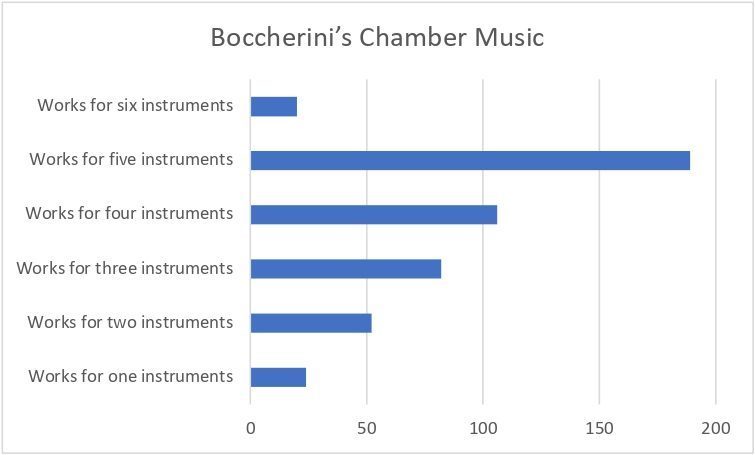
Figure1. Typologies of most common works within Boccherini’s chamber music
According to their instrumentation, in Gérard’s catalogue it is possible to distinguish three groups: 66 compositions written for two violins and cello, or for violin, viola and cello (G 77-142); 11 works for harpsichord (or pianoforte), violin and cello (G 143-153); and 5 compositions for various combinations of three instruments (G 154-158).
Of all of these, 42 works belonging to the first group (G 77-118) are autographs; that is, they appear in the authentic catalogues of the works of Luigi Boccherini (Figure 2). A large share of the autographs was kept by the composer himself and passed to his heirs, arranged in 10 fascicles; these were later lost.8In Gérard’s catalogue it is stated that these were burned during the Civil War, though this assertion was refuted by José Antonio Boccherini. JAIME TORTELLA, Errors, myths and legends around Luigi Boccherini, «Boccherini online», 1, 2008, pp. 19-42.
The attribution of the rest of the works of this group (G 119-142) is doubtful. The first edition of Nos. 119-124 (Op. 3) was published in 1768 in Paris by Louis-Balthazar de La Chevardière (1758-1784). Picquot considers that this work, “which I do not believe to be by Boccherini, appears to me to be the product of a commercial speculation”.9PICQUOT, Notice, p. 110. Pina Carmirelli, on the other hand, who gave performances of these trios, thought that they could be attributed to Boccherini.10GERARD, Thematic, bibliographical and critical catalogue, p. 134.Also, the authenticity of the six trios published as Op. 7 (G 125-130) has been questioned. The authors of the Dictionnaire historique des musiciens (1835-1844) declared that they were written by Luigi Marescalchi (1745-1812), a Venetian music-publisher. However, Picquot and Gérard consider that they were the work of Boccherini. Even if they do not attain the high musical quality of the trios and quartets of 1760-1761, important stylistic analogies are nevertheless present in them.11Ibid., p. 141.
The six trios of Op. 28 (G 131-136) are also “doubtful” works that might be musical forgeries written by Giuseppe Cambini (1746-1825?).12PICQUOT, Notice., p. 124.Certainthemes derive from earlier works of Boccherini, without alterations; others are “clumsy imitations”.13GERARD, Thematic, bibliographical and critical catalogue, p. 147. Lastly, the attribution to Boccherini of the six divertimenti (G 137-142) in the Prague MS. is considered incorrect. One hypothesis holds that the confusion has its origin in an incorrect spelling of the composer’s surname (“Boccarini” or “Poccarini”).14Ibid., p. 152.
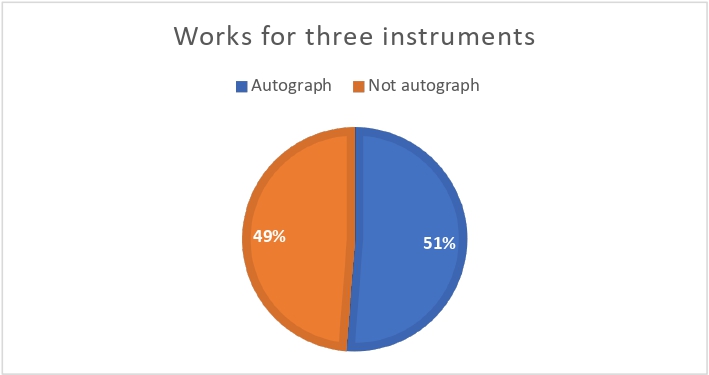
Figure 2. Authenticity of Boccherini’s sources in the works for three instruments
Most of the autographed trios and two of the non-original trios for two violins and cello (G 122 and 125) were transcribed as works for two instruments or as other trios, quartets and string quintets. In contrast, some works for harpsichord (or pianoforte), violin and cello, and other combinations of three instruments (G 149-158) are transcriptions from quintets and arrangements of other trios, written variously by the publisher Ignace Pleyel (1757-1831), the Marquis de Louvois, Franz Joseph Hérold (1791-1833), and other unknown composers.
Transcriptions from autograph trios
As Cecilia González Martín stated in her study of Boccherini’s duets,15GONZALEZ MARTIN, The transcriptions, pp. 13-20. transcriptions were made not only from pre-existing complete works, but also from individual movements of different works. The same is true of his works for three instruments. Transcriptions may consist of individual movements from different trios or be adaptations of entire trios, and most were published within a few years of publication of the original trio from which they were adapted. Table 1 lists Boccherini’s autograph trios and the transcriptions made from them, and Table 2 presents information on these transcriptions.

Table 1. Boccherini’s autograph trios that have been transcribed
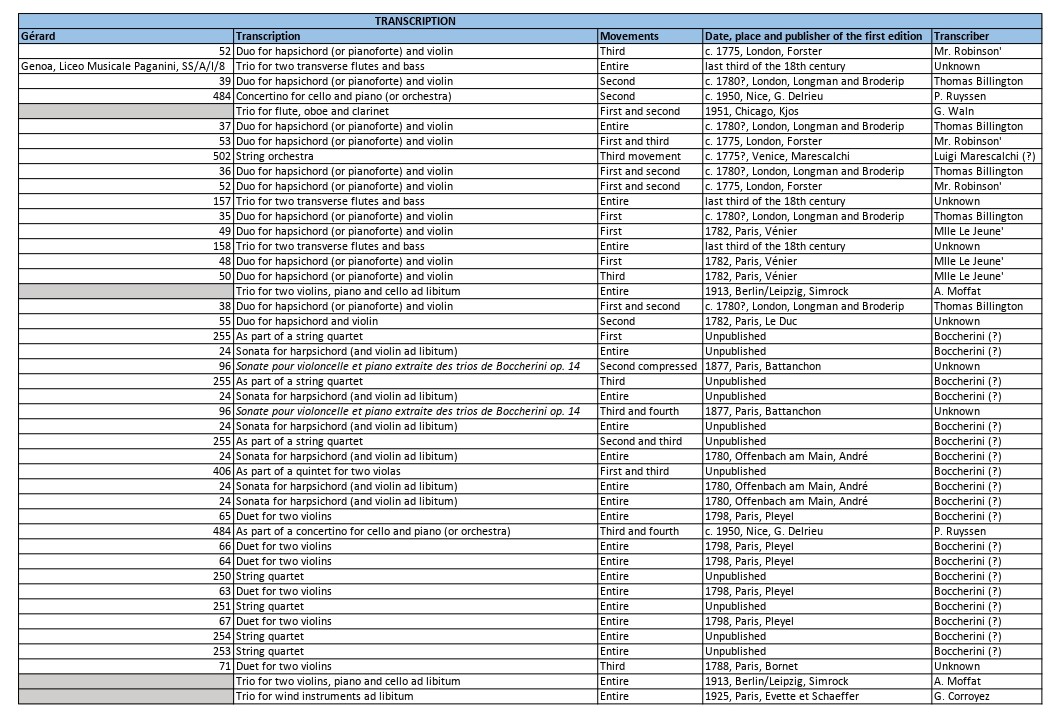
Table 2. Transcriptions from Boccherini’s autograph trios
A good example that illustrates this transcription practice is the Concertino in G Major for cello and piano (or conceivably for orchestra) (G 484). The second movement of the Trio in G Major Op. 1 No. 5 (G 81), was transcribed as its first movement. The other two remaining movements come from the third and fourth movements of the Trio in G Major Op. 34 no. 2 (G 102) (Table 3). This Concertino was written by Pierre Ruysen (1892-1965) and published around 1950.16G. DELRIEU, Concertino […] recueilli et adapté par Pierre Ruysen (reduced score for cello and piano), Nice, c. 1950

Table 3. The origin of the movements of the Concertino in G Major for cello and piano (or orchestra?)
The Quartet in D Major for two violins, viola and cello (Op. 54 No. 6 G 255) is another transcription from individual movements of trios; it comprises the first movement of the Trio in F Major Op. 14 No. 1 (G 95), the second and third movement of the Trio in D Major Op. 14 No. 4 (G 98), and the third movement of the Trio in C Minor Op. 14 No. 2 (G 96) (Table 4).

Table 4. Origins of the movements of the Quartet in D Major for two violins, viola and cello
A different approach can be found in quartets G 251, G 253 and G 254, which are transcriptions of whole trios. The Quartet in G Major for two violins, viola and cello (Op. 54 No. 2) is based on the Trio in G Major Op. 54 No. 2 of 1796 (G 114). The Quartet in A Major Op. 54 No. 4 is a transcription of the entirety of the Trio in A Major Op. 54 No. 6 (G 118). Lastly, the Quartet in C Major Op. 54 No. 5 is an adaptation of the Trio in C Major Op. 54 No. 4 (G 116).
Picquot considered that the author of the four above-mentioned quartets may have been Boccherini himself. However, Gérard is inclined to place these quartets in the category of doubtful works. Despite their high quality, the presentation of the text does not in some respects follow Boccherini’s regular practice. All of them are unpublished and appear in a manuscript dated 1796 and preserved in the Library of Congress in Washington under the title Opera 54, 1796, Tre quartetti per due violini, viola e basso composti del Sigr Luigi Boccherini.17GERARD, Thematic, bibliographical and critical catalogue, pp. 272-273. Curiously, the original trios were written in that same year (1796). Therefore, the transcriptions and the originals must have been written at practically the same time. Another possibility is that the year (“1796”) that appears in the mentioned title of the quintets could refer not to the quartets but to the original trios.
Most likely, the popularity of the trios led to the creation of adaptations for a greater number of instruments. Some trio movements were even used in string quintets and other compositions for orchestra. Thus, the first and third movement of the Trio in Eb Major Op. 14 No. 5 for two violins and cello (G 99) were used as part of a quintet for two violins, two violas and cello (G 406). The author was possibly Boccherini himself, given Picquot’s affirmation that: “I possess a quintet for two violins, two violas and cello, arranged by Boccherini from the Andantino and the Andantino con variazioni of the 5th trio in Eb. I do not know whether the composer arranged the other pieces of this remarkable work [Op. 14] in the same fashion”.18PICQUOT, Notice, p. 118. The precise manuscript in Picquot’s possession cannot be traced, but it has been attested that Boccherini himself made transcriptions of his own works on several occasions.19On the transcriptions that Boccherini made before 1785 for quartet and quintet (untraced today), see GERMAN LABRADOR LOPEZ DE AZCONA, Luigi Boccherini’s lost music and a new chronology for his works: an unknown inventory from 1785, «Philomusica on-line», 15/2, 2016, pp. 112-115. A later example is described in LOUKIA DROSOPOULOU, Luigi Boccherini’s string quintets with two violas Opp. 60 and 62 (G 391-402). A re-examination of their origin, in Boccherini studies, vol. 3, ed. Christian Speck, Bologna, Ut Orpheus, 2011, pp. 169-196.
Also, the third movement of the Trio in Eb Major Op. 4 No. 1 (G 83) was transcribed, apparently by Marescalchi,20GERARD, Thematic, bibliographical and critical catalogue, p. 566. as part of the Minuet No. 2 in Eb Major for orchestra (two violins, viola, bass, two oboes and two horns).
Nevertheless, as Cecilia González Martín showed in her study, most of the trios were transcribed for two instruments.21GONZALEZ MARTIN, The transcriptions, p. 15.Sometimes the same movement of a trio is found in several sonatas. For instance, the first and second movements of the Trio Op. 4. No. 2 of 1766 (G 84) were used in the Sonata in Bb Major (No. 3) for harpsichord (or pianoforte) and violin obbligato (G 36) edited by Thomas Billington, probably in 1780, but also in the Sonata in Bb Major (No. 1) for the same instruments (G 52) by a certain Mr. Robinson around 1775. Both sonatas were published in years close to those of the original trio’s publication in 1768.
Transcriptions of string trios as wind trios are not very common. In Gérard’s catalogue, we find only three transcriptions from the last third of the 18th century: the Trio in Bb Major Op. 1 No. 2 (G 78), transcribed for two transverse flutes and bass; and for the same combination of instruments, the Trio in Bb Major Op. 4 No. 2 (G 84 as G 157) and the Trio Op. 5 No. 5 (G 87 as G 158). The author of these transcriptions is unknown but was perhaps an amateur flautist.22Ibid., p. 169. In addition, there are two early 20th century arrangements; one of the Trio in C Major Op. 1 No. 6 (G 82) as a trio for flute, oboe and clarinet, and other of the Trio in C Minor (no. 1) for two violins and cello (G 125) transcribed for wind instruments ad libitum.
Trios that are transcriptions of other works
As seen in Tables 5 and 6, most of the works for three instruments G 149-154 are transcriptions of quintets. All of these quintets are included in Boccherini’s autograph catalogue.

Table 5. Trios that are transcriptions of Boccherini’s works

Table 6. Boccherini’s works that were transcribed as trios
The sonatas for pianoforte, violin and cello (G 149-151) are based entirely in original quintets. The three G 149 sonatas were published as one volume by Pleyel, and, according to Gérard, the G 150 and G 151 sonatas were intended to be part of a second volume of three sonatas; however, the Sonata in D Minor (G 150) was the only one ultimately published.23Ibid., p. 165. These quintets were also published by Ignace Pleyel, and some of them (G 357, G 360, G 361 and G 377) were published years after the “sonatas” (trios) that were adapted from them were first issued (G 149, G 150 and G 154; see Tables 5 and 6). In the case of the Quintet G 357, as many as 15 years would have passed. This would illustrate Pleyel’s disregard for Boccherini’s original work and the predominance of commercial interests in his publishing policy. In other words, “non-original” Boccherini’s music was published (and known to the public as a transcription) earlier than the original quintets that the composer sold to Pleyel. Thus, it appears that the aim of music publishers such as Pleyel and those cited in Tables 5 and 6 was merely to make “Boccherini’s music” available, without concern for the authenticity of the result. Works for three instruments probably sold better at the time, requiring only three musicians, and Pleyel would have taken advantage of the quintets to make transcriptions for other combinations of instruments. For example, the Quintet Op. 49 No. 4 (G 368) was also published as a quartet for flute and strings (G 260).
The Marquis de Louvois is the author of two other trios (G 152 and 153), transcribed from the quintets Op. 25 No. 1 and Op. 42 No. 4, respectively. These trios were printed in Paris by Maurice Schlesinger and probably published around 1835. In this case, the publisher of the transcriptions was not the same who had published the originals. The editor of the G 295 quintet was Artaria, in Vienna, around 1785. The other was Pleyel, in Paris, and probably in 1802.
Closing remarks
Half of Boccherini’s trios included in Gérard’s catalogue are original works, and most of them are written for two violins and cello, or for violin, viola and cello. Most of them were published in Paris a few years after their appearance, according to Boccherini’s authentic catalogues, and their main editors were Vénier, La Chevardière, Bailleux and Pleyel. From these compositions, as shown in Tables 1 and 2, new transcriptions for different instrumental forces were created by means of adapting either entire trios or single movements from different works. In this way, trios for wind instruments, string quartets and quintets, and other compositions for orchestra appeared in the market from 1775 onward. These transcriptions were normally published a few years after the original.
Other trios that appear in Gérard’s catalogue are not original compositions but transcriptions, mostly from autograph quintets. They are written for pianoforte, violin and cello and have been compiled in Tables 5 and 6. Thus the repertoire for pianoforte, which had become very common in the second half of the 18th century, was expanded, and publishers profited by making adaptations for this instrument.
The lack of works by Boccherini’s with pianoforte was a major reason for publishers to provide the public with transcriptions of “Boccherini’s sonatas”. These transcriptions were mainly published in Paris, subsequently expanding the dissemination of Boccherini’s music throughout Europe.
Some cases have been documented in which the “inauthentic” trios may have been published years before the original Boccherini’s quintets: these are the G 357, G 360, G 361 and G 377 quintets. These examples would prove once again that music publishing was a business whose aim was to meet the needs of the market. It may have been regarded as better to publish “inauthentic” works since at that time “fidelity to the original” was a matter of minor relevance – if any – for both the public and music publishers.
The phenomenon of transcriptions in Boccherini’s work demonstrates on the one hand the popularity that Boccherini’s trios acquired. A good example are the trios Op. 4 and Op. 14, most of them transcribed by “Mr. Robinson” in 1775 and then by Thomas Billington in 1780 (both in London) precisely because they were well-known works. On the other hand, it also underlines the importance of transcriptions to the publishing market.
The present study further confirms the thesis defended by Cecilia González Martín about the importance of printed music in the history of Boccherini’s reception. Beyond the need to consult the most authoritative sources for each work, attention must also be paid to the reality of Boccherini’s music in his own time, which was disseminated to a great extent through adaptations in which he did not intervene.
| 1. | ↑ | WILLI APEL, Transcription, in The Harvard Dictionary of Music, 2nd ed., Cambridge (MA), The Belknap Press of Harvard University Press, 1975, p. 56. |
| 2. | ↑ | A good example would be the Trio No.7 G 83 for two violins and cello, in Eb Major, which was transcribed as a minuet for two violins, viola, bass, two oboes and two horns. |
| 3. | ↑ | CECILIA GONZALEZ MARTIN, The transcriptions for two instruments in Luigi Boccherini’s catalogue, «Boccherini online», 6, 2013, pp. 13-20. YVES GERARD, Thematic, bibliographical and critical catalogue of the works of Luigi Boccherini, London etc., Oxford University Press, 1969. |
| 4. | ↑ | LOUIS POCQUOT, Notice sur la vie et les ouvrages de Luigi Boccherini: suivie du catalogue raisonné de toutes ses œuvres, tant publiées qu’inédites, Paris, chez Philipp, 1851. |
| 5. | ↑ | ALFREDO BOCCHERINI y CALONJE: Luis Boccherini. Apuntes biográficos y catálogo. Madrid, Imprenta y Litografia de A. Rodero, 1879. Modern, facsimile edition: Boccherini en familia, Madrid-Sant Cugat, Asociación Luigi Boccherini & Editorial Arpegio, 2010. On Boccherini’s catalogues see MARCO MANGANI – FEDERICA ROVELLI: Boccherini’s Thematic Catalogues: “A Reappraisal” in Understanding Boccherini’s Manuscripts, ed. Rudolf Rasch, Newcastle-upon-Tyne, Cambridge Scholars Publishing, 2014, pp. 109–28. |
| 6. | ↑ | GERARD, Thematic, bibliographical and critical catalogue. |
| 7. | ↑ | Concerning the first editions of Boccherini’s autograph works, we will use the dates provided by Rudolf Rasch in his 2007 article when the exact year (or an approximation) is provided. See RUDOLF RASCH, Luigi Boccherini and the Music Publishing Trade, in Boccherini studies, vol. 1, ed. Christian Speck, Bologna, Ut Orpheus, 2007, pp. 124-127. For the transcriptions, we will rely on Gérard’s catalogue. |
| 8. | ↑ | In Gérard’s catalogue it is stated that these were burned during the Civil War, though this assertion was refuted by José Antonio Boccherini. JAIME TORTELLA, Errors, myths and legends around Luigi Boccherini, «Boccherini online», 1, 2008, pp. 19-42. |
| 9. | ↑ | PICQUOT, Notice, p. 110. |
| 10. | ↑ | GERARD, Thematic, bibliographical and critical catalogue, p. 134. |
| 11. | ↑ | Ibid., p. 141. |
| 12. | ↑ | PICQUOT, Notice., p. 124. |
| 13. | ↑ | GERARD, Thematic, bibliographical and critical catalogue, p. 147. |
| 14. | ↑ | Ibid., p. 152. |
| 15. | ↑ | GONZALEZ MARTIN, The transcriptions, pp. 13-20. |
| 16. | ↑ | G. DELRIEU, Concertino […] recueilli et adapté par Pierre Ruysen (reduced score for cello and piano), Nice, c. 1950 |
| 17. | ↑ | GERARD, Thematic, bibliographical and critical catalogue, pp. 272-273. |
| 18. | ↑ | PICQUOT, Notice, p. 118. |
| 19. | ↑ | On the transcriptions that Boccherini made before 1785 for quartet and quintet (untraced today), see GERMAN LABRADOR LOPEZ DE AZCONA, Luigi Boccherini’s lost music and a new chronology for his works: an unknown inventory from 1785, «Philomusica on-line», 15/2, 2016, pp. 112-115. A later example is described in LOUKIA DROSOPOULOU, Luigi Boccherini’s string quintets with two violas Opp. 60 and 62 (G 391-402). A re-examination of their origin, in Boccherini studies, vol. 3, ed. Christian Speck, Bologna, Ut Orpheus, 2011, pp. 169-196. |
| 20. | ↑ | GERARD, Thematic, bibliographical and critical catalogue, p. 566. |
| 21. | ↑ | GONZALEZ MARTIN, The transcriptions, p. 15. |
| 22. | ↑ | Ibid., p. 169. |
| 23. | ↑ | Ibid., p. 165. |